How to start a research paper, and why you should
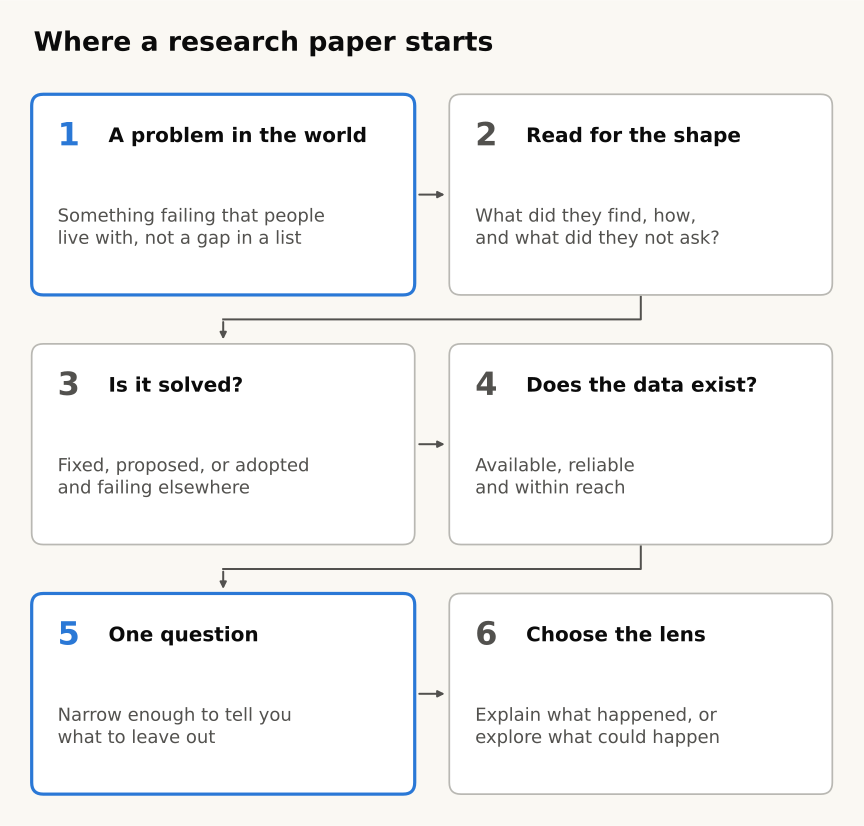
Original diagram for EKO Perspectives.
A research paper does not begin with a method. It begins with a problem you cannot stop thinking about. The method comes later, once you have read enough to know what has been done, what has not, and what the data you can get will actually answer. Starting from the method, or from a dataset, or from a gap someone told you exists, tends to produce a paper that is technically competent and empty. It answers a question nobody was asking.
The paper that matters starts with something happening in the world that harms people or land and is not being fixed. Illegal gold mining that turns Ghana’s rivers brown despite years of crackdowns. A US tax credit that scores corn ethanol as though the land it uses were free. Forest carbon credits sold for more avoided clearing than the forests could have supplied. A European trade rule that may divert deforestation to other markets rather than stop it. Each is a failure first and a gap in the literature second. The research exists because the failure is real and the response has not worked.
Read for the shape of the field
Once you have the problem, you read. Not everything, but enough to see the shape of the field. Three questions are worth asking of every paper: what did they find, how did they find it, and what did they not ask? The third matters most, because the unasked question is where your paper will live.
Suppose the literature has established that illegal mining is widespread and enforcement weak, but nobody has compared arrests with prosecutions across districts. That comparison is an opening. Suppose it has established that corn ethanol has a land-use problem and that the law now ignores it, but nobody has traced how the exclusion was written and who argued for it. That would be another. A useful gap is rarely an absence of papers. It is the missing question that would explain why the failure persists.
Mats Alvesson and Jörgen Sandberg made a version of this argument in 2011, against what they called gap-spotting: the habit of arriving at research questions by finding holes in existing theory rather than challenging its assumptions. Starting from a failure in the world pushes you towards the second, because a failure usually means somebody’s assumptions were wrong.
Ask whether it is solved
The next question separates a research paper from a literature review. Has anyone actually fixed this? Not proposed a fix or modelled one, but fixed it.
If nobody has, the paper is necessary. If a fix exists but has not been adopted, the paper is about the distance between evidence and policy. If a fix has been adopted somewhere, the paper is about why it worked there and whether it would work here. The answer decides what kind of paper you are writing, and it is worth settling before you write a word.
Ask whether the data exist
This is the question that kills most ideas, and it should. A good question without data is a wish. Before committing, you need to know whether the data exist, whether they are reliable and whether you can get them. Sometimes they are buried in government reports. Sometimes they are proprietary. Sometimes they do not exist at all and you have to collect them, which changes the scope, the timeline and often the question.
The test is not whether the data would be nice to have. It is whether you can obtain them and whether what you obtain can answer what you are asking.
Settle on one question
“Illegal mining in Ghana” is a topic. “Why do arrests for illegal mining in Ghana so far outnumber prosecutions, and what does the gap reveal about the political economy of enforcement?” is a question. A topic can absorb anything. A question tells you what to include, what to leave out and when you have finished. It also tells the reader what you are arguing. A paper without a question is a report.
Choose the lens
There are two broad ways to frame the question, and they answer different things. Explanatory work asks what is happening, why, and what should be done. It works from observed data and established methods, and its findings can be tested against what actually happened.
Foresight asks what could happen and what we would need to do now to be ready for a range of futures. It uses scenarios, models and often participatory methods. Its scenarios are not forecasts and carry no probabilities. Their value is in showing decision-makers how outcomes depend on choices and conditions that have not yet been observed, which is why scenario models matter when climate targets push policy beyond the range of historical data. Much of the modelling around my own PhD sits in that tradition.
Neither lens is better. If a problem is well documented and the policy response has failed, explanatory analysis can show why. If a problem is emerging and the data do not yet exist, foresight can help decide what to measure. Many good papers use both. The skill lies in knowing which one the question demands.
Why start at all
Publication is not the reason. The reason is that the problem is real and the people living with it rarely have the time, money or access to study it themselves: farmers whose land is being priced into someone else’s climate target, communities near rivers carrying mercury and silt, smallholders asked to prove the origin of every bag they sell. A paper cannot fix any of this. It can document what is happening, explain why, and leave a record that others can use to argue for change.
The best papers start with a problem that is obvious to the people who live with it and invisible to the people who write the rules. Their job is to make it visible to the second group. The method serves that job. The data make it possible. The question comes from the problem, and the problem comes from the world.
Elvis Kwame Ofori
Researcher and writer behind EKO Perspectives.
More from EKO Perspectives · Follow via RSS · About the author